
Connecticut Bankruptcy Records Database
Connecticut bankruptcy records are federal court documents filed with the United States Bankruptcy Court for the District of Connecticut. These records contain detailed information about debt relief cases including petitions, schedules of assets and liabilities, creditor lists, and discharge orders. You can search for Connecticut bankruptcy filings through PACER, the federal court's online case management system, or visit one of three divisional offices located in Hartford, Bridgeport, and New Haven.
Connecticut Bankruptcy Court Quick Facts
Where to Find Connecticut Bankruptcy Records
The United States Bankruptcy Court for the District of Connecticut maintains all bankruptcy case files for residents across the state. This federal court has exclusive jurisdiction over bankruptcy matters. Cases are heard at three divisional offices. The Hartford Division sits in the Abraham Ribicoff Federal Building at 450 Main Street. Bridgeport Division operates from the Brien McMahon Federal Building at 915 Lafayette Boulevard. New Haven Division is located in the Connecticut Financial Center at 157 Church Street. Each office maintains public access terminals for viewing case documents.
Filing for bankruptcy in Connecticut creates a permanent federal record. These case files include the voluntary petition, schedules listing all property and debts, statement of financial affairs, and the court's discharge order. Most cases filed since 1998 are available electronically through the court's CM/ECF system. Older cases may be archived at the Federal Records Center in Waltham, Massachusetts. The National Archives and Records Administration handles retrieval requests for archived files. Contact the Clerk's Office first to confirm file location before submitting a NARA request.
The official website for the U.S. Bankruptcy Court for the District of Connecticut provides comprehensive information about accessing records. Visit www.ctb.uscourts.gov for court locations, hours, and contact information. The court's case information page at www.ctb.uscourts.gov/case-info explains all available access methods in detail.
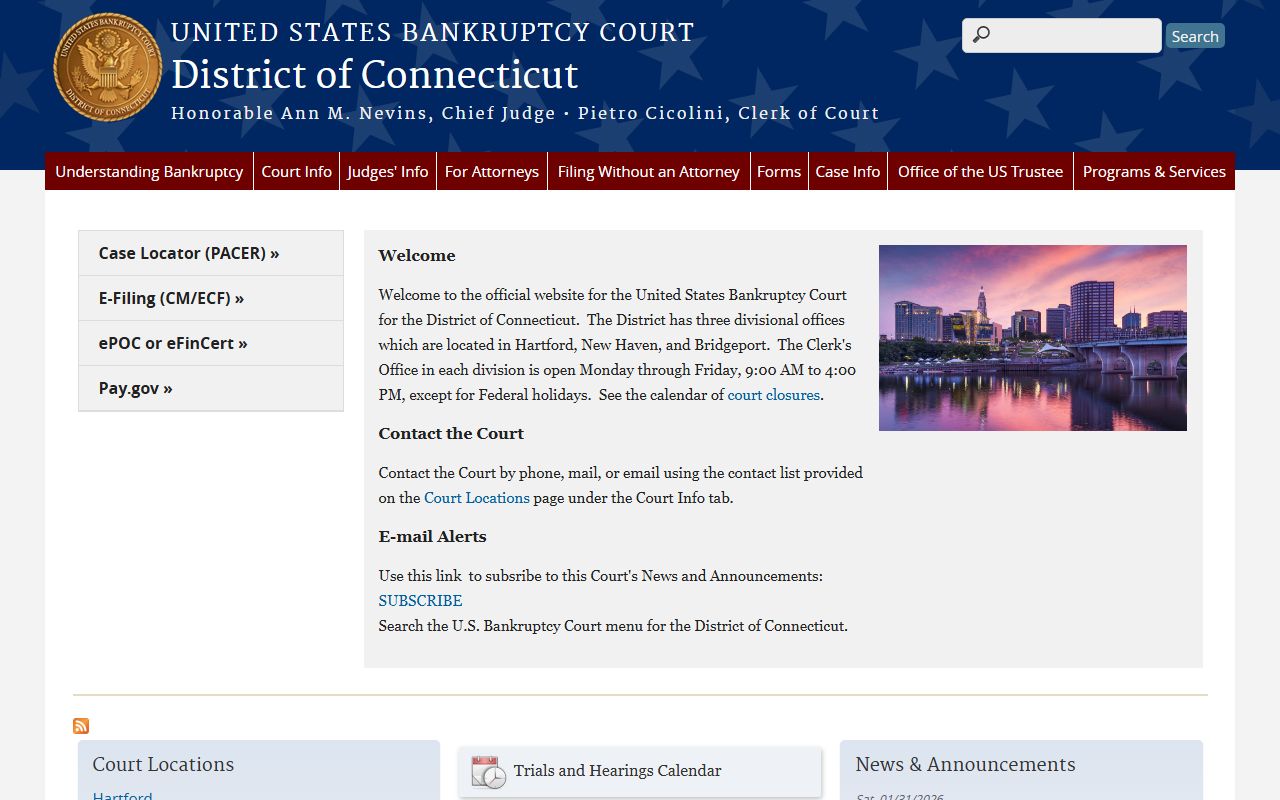
The Connecticut Bankruptcy Court homepage provides direct access to case lookup tools, forms, and divisional office information for Hartford, Bridgeport, and New Haven locations.
How to Search Connecticut Bankruptcy Records Online
PACER offers the most comprehensive online access to Connecticut bankruptcy records. This federal system contains case summaries, docket sheets, and viewable copies of documents filed since 1998. Registration is required at pacer.uscourts.gov. The cost is $0.08 per page with a maximum charge of $30.00 per document. Users pay nothing if quarterly usage stays below $30. PACER covers all federal appellate, district, and bankruptcy courts nationwide. This makes it the single best resource for researching bankruptcy filings across Connecticut and beyond.
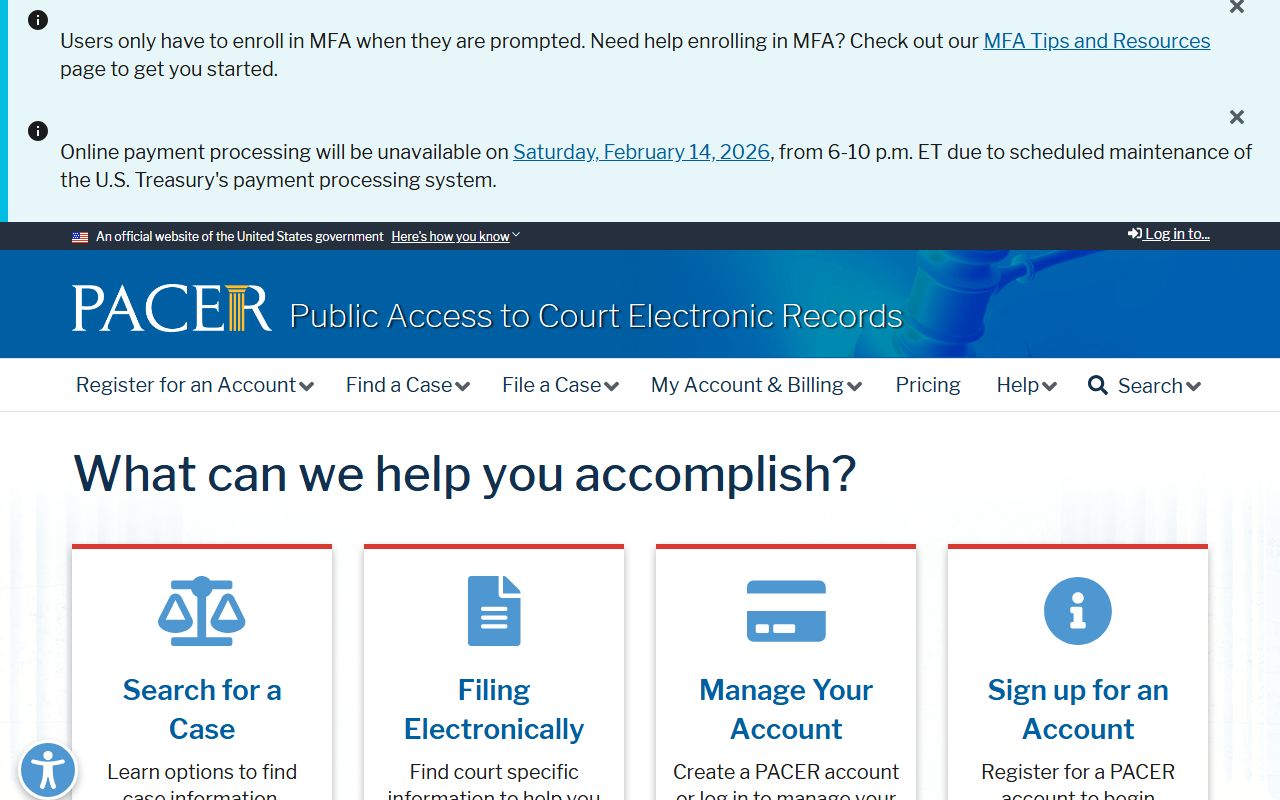
PACER provides nationwide access to federal court records including all Connecticut bankruptcy filings with document images and case status information.
The Voice Case Information System provides free basic case details by phone. Call 1-866-222-8029 from any touch-tone phone, 24 hours daily. VCIS offers debtor names, case numbers, filing dates, trustee assignments, 341 meeting dates, and case status. This automated system works well for quick lookups when full document access is not required. No registration is needed for VCIS access. Information updates nightly from the court's live database.
Attorneys use CM/ECF for electronic filing and case management. The public can view case information through this system at ecf.ctb.uscourts.gov. Registration requires contacting the court at ctb_ecf_registrations@ctb.uscourts.gov. CM/ECF offers real-time access to newly filed documents. The system sends automatic email notices to case participants when new entries post. For technical support, email ctb_ecf_help@ctb.uscourts.gov.
CM/ECF serves as the court's electronic filing platform where attorneys and trustees file documents and manage Connecticut bankruptcy cases.
Types of Connecticut Bankruptcy Records Available
Connecticut bankruptcy courts create extensive documentation for each case. The voluntary petition starts the process. This document identifies the debtor and requests relief under specific bankruptcy chapters. Chapter 7 cases involve liquidation of non-exempt assets. Chapter 13 establishes three to five year repayment plans. Chapter 11 handles business reorganizations. Each chapter generates unique record types and filing requirements.
Schedules form the core financial disclosure in every case. Debtors must list all assets, liabilities, income, and expenses. Schedule A details real property. Schedule B covers personal property. Schedules D, E, and F list secured, priority, and unsecured creditors. The statement of financial affairs provides additional background about financial history. These documents create a complete picture of the debtor's financial situation.
The 341 meeting of creditors produces an official transcript. This meeting occurs 20 to 40 days after filing. The trustee questions the debtor under oath. Creditors may attend and ask questions. This hearing transcript becomes part of the permanent record. Discharge orders represent the final court action. This order releases the debtor from personal liability for most debts. The discharge creates a permanent injunction against collection efforts.
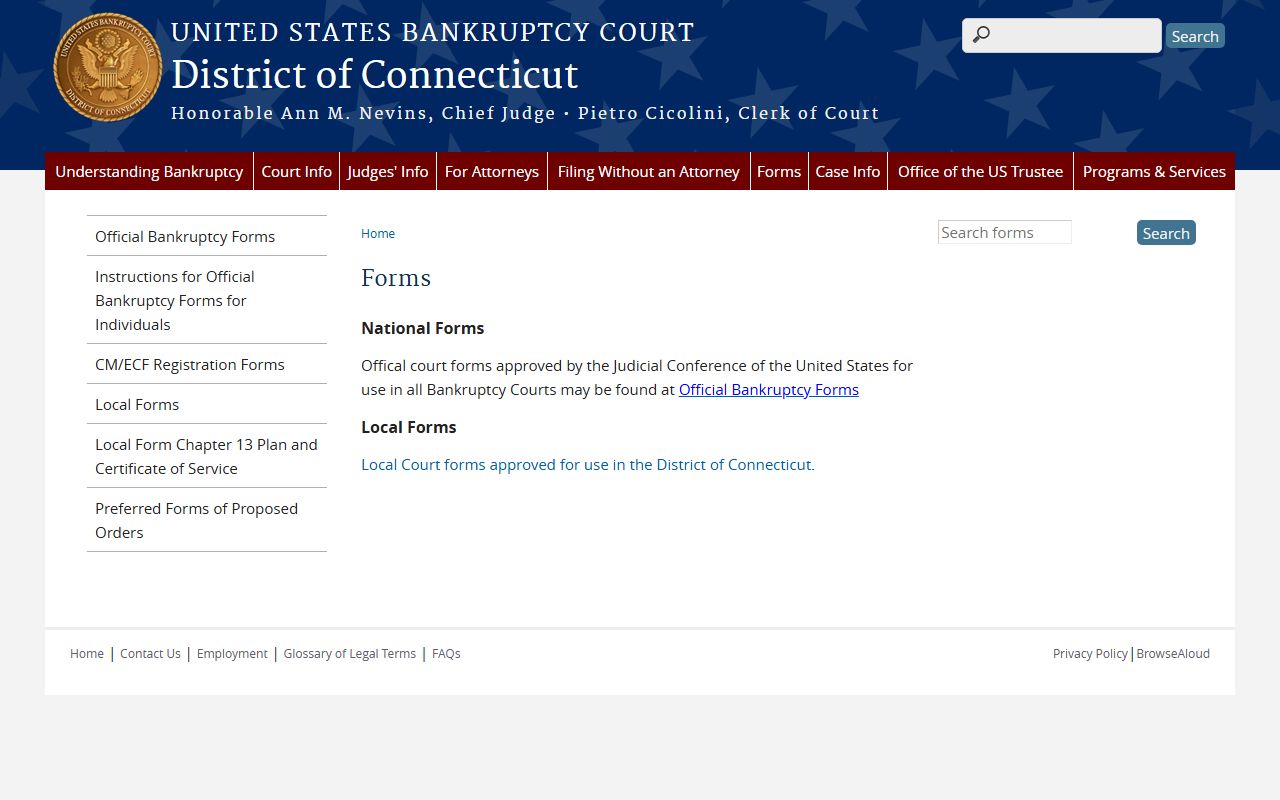
Official bankruptcy forms establish the foundation of every case file submitted to the Connecticut Bankruptcy Court.
Connecticut bankruptcy records typically contain:
- Voluntary petition and case initiation documents
- Schedules of assets, debts, and financial affairs
- Creditor matrix with complete mailing addresses
- Trustee reports and recommendations
- 341 meeting transcripts and creditor communications
- Court orders, motions, and adversary proceedings
- Discharge orders and case closing documents
Adversary proceedings create separate litigation records within bankruptcy cases. These lawsuits address contested matters. Objections to discharge fall into this category. Fraudulent transfer claims also generate adversary proceedings. Each proceeding receives its own case number and docket. These records remain accessible through PACER and court terminals. Adversary proceedings require a separate $350 filing fee.
Connecticut Bankruptcy Court Locations and Hours
The Hartford Division serves the northern portion of Connecticut. Located at 450 Main Street on the 7th floor, this office handles a significant volume of Chapter 7 and Chapter 13 cases. The Clerk's Office phone is 860-240-3675. General correspondence goes to ctb_correspondence@ctb.uscourts.gov. Hours run Monday through Friday from 9:00 AM to 4:00 PM, excluding federal holidays. Public access terminals are available for self-service record viewing.
Bridgeport Division covers Fairfield County and southwestern Connecticut. The office sits at 915 Lafayette Boulevard in the Brien McMahon Federal Building. Contact the Clerk's Office at 203-579-5808. This division processes many cases from high-population areas including Bridgeport, Stamford, and Norwalk. The same email and hours apply as Hartford. Directions and parking information are available on the court's website.
New Haven Division occupies the 18th floor of the Connecticut Financial Center at 157 Church Street. The phone number is 203-773-2009. This office serves New Haven County and surrounding areas. All three divisions accept filings from any Connecticut resident. Debtors may choose the most convenient location. Case assignment depends on the debtor's county of residence.
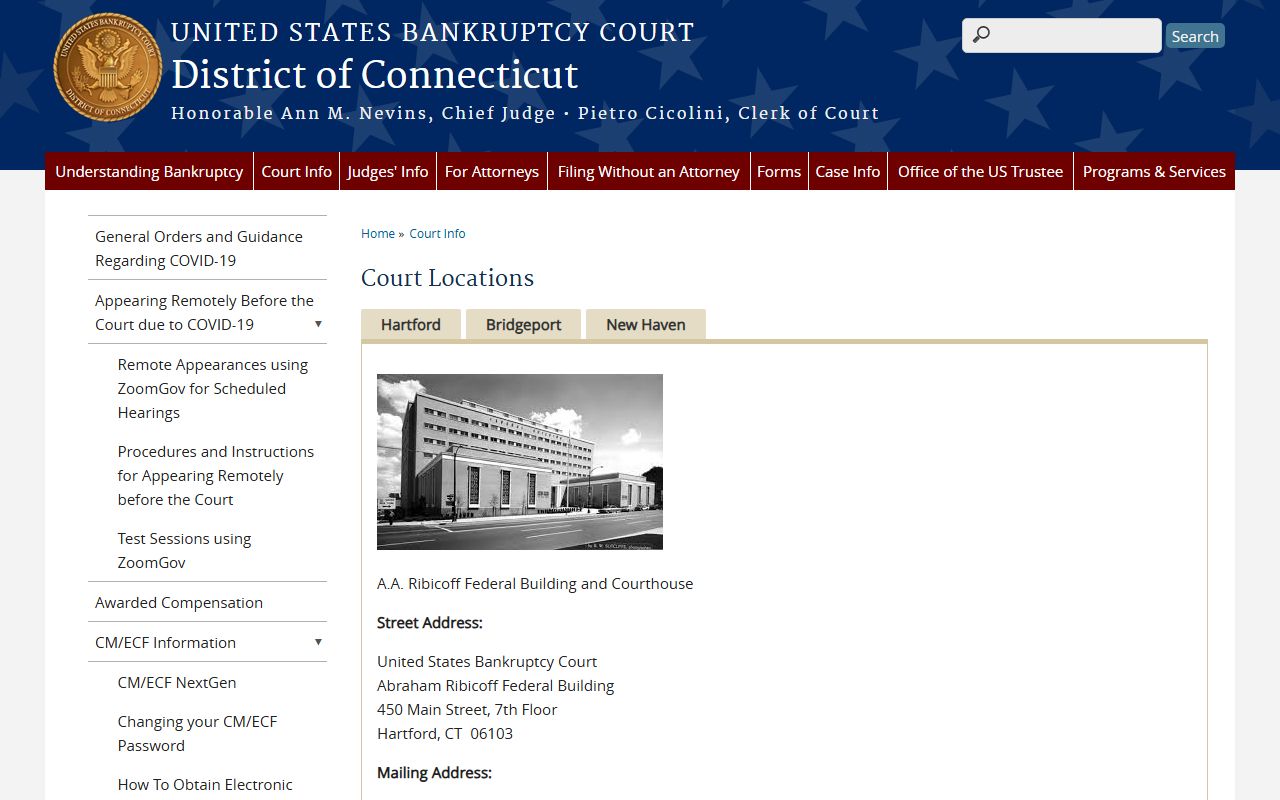
The court locations page provides complete contact information for all three divisional offices serving Connecticut residents.
Chief Judge Ann M. Nevins presides over the District of Connecticut. Clerk of Court Pietro Cicolini manages administrative operations. Courtroom deputies handle scheduling and hearing logistics for each division. Contact information for specific judges' chambers is available through the Clerk's Office. The court maintains local rules that supplement federal bankruptcy procedures. These rules are available at www.ctb.uscourts.gov/local-rules-effective-august-2-2021.
Bankruptcy Filing Fees and Copy Costs in Connecticut
Federal law establishes fees for bankruptcy cases under 28 U.S.C. § 1930. These fees apply nationwide including Connecticut. Chapter 7 filings cost $338.00 as of December 1, 2023. Chapter 13 cases require $313.00. Chapter 11 petitions carry a $1,738.00 fee. Chapter 12 family farmer cases cost $278.00. Adversary proceedings require $350.00. Motion fees vary based on the relief requested.
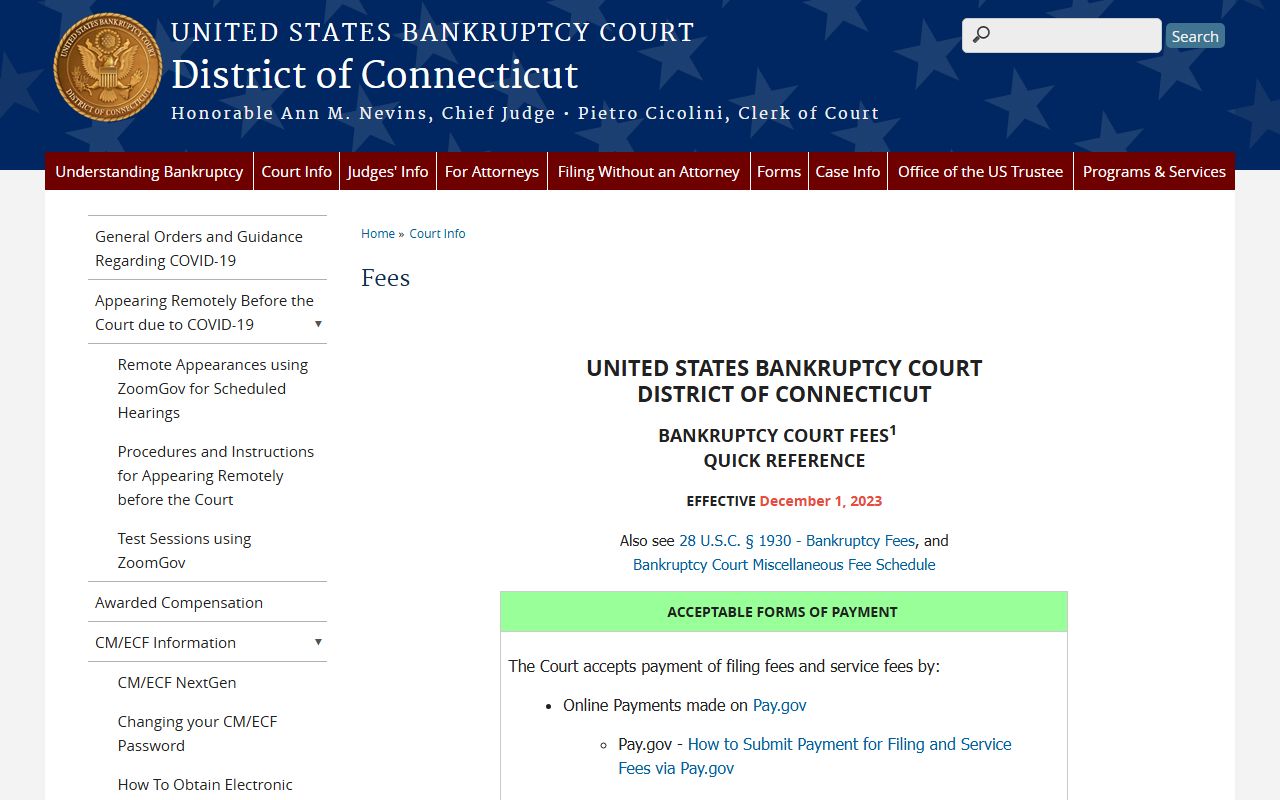
The fee schedule outlines all required payments for filing cases, motions, appeals, and obtaining copies of Connecticut bankruptcy records.
Fee waivers are available for qualifying Chapter 7 debtors. Under 28 U.S.C. § 1930(f), individuals with income below 150% of federal poverty guidelines may request waiver. File the Application to Proceed in Forma Pauperis with the voluntary petition. The court reviews financial documentation before granting relief. Fee waivers are not available for Chapter 13 or Chapter 11 cases.
Payment options include cash, money orders, bank checks, and credit cards. Personal checks from debtors are not accepted for filing fees. Attorneys may pay from trust accounts. Online payments use Pay.gov at www.pay.gov/public/form/start/73185821. Instructions are available on the court website. Make all checks payable to "Clerk, United States Court" or "Clerk, U.S. Bankruptcy Court."
Copy fees differ based on access method. Self-service from public computers costs $0.10 per page. Copy machine access for archived cases runs $0.25 per page. Staff-assisted searches have additional charges. Electronic record retrieval costs $11.00 per request. Certification adds $12.00 per document. Exemplification costs $24.00. Contact Finance@ctb.uscourts.gov with payment questions.
Note: Filing fees change periodically. Always verify current costs before submitting payment to the Connecticut Bankruptcy Court.
Connecticut Bankruptcy Exemptions and Protections
Connecticut law protects certain property in bankruptcy cases. These exemptions determine what assets debtors keep after filing. The Connecticut General Statutes Title 52, Chapter 925 establishes state exemption amounts. Debtors may choose between Connecticut or federal exemptions. This choice affects the amount of protected equity in homes, vehicles, and personal property.
The homestead exemption increased significantly in 2021. Connecticut now protects up to $250,000 in home equity per filer. Married couples filing jointly may protect up to $500,000. This applies to houses, condominiums, and mobile homes. The property must be the debtor's principal residence. This generous exemption helps many Connecticut homeowners keep their homes through bankruptcy.
Motor vehicle exemptions in Connecticut provide $3,500 in equity protection. Federal exemptions offer $4,450 for vehicles. Personal property faces no dollar limits under Connecticut law. Furniture, appliances, clothing, wedding rings, and food are fully exempt. Health aids and burial plots also receive complete protection. Federal exemptions place caps on general personal property.
Retirement accounts receive strong protection in Connecticut. 401(k) plans, IRAs, and defined benefit pensions are 100% exempt. Teacher retirement plans and state employee plans are fully protected. Federal law also shields most retirement assets. This protection helps debtors maintain long-term financial security despite bankruptcy. The federal IRA exemption has a limit of $1,512,350 total.
Tools of trade receive complete exemption in Connecticut. This includes books, equipment, and livestock needed for work. Federal law limits this exemption to $2,800. Debtors must choose one system. Mixing state and federal exemptions is not permitted. Careful analysis determines which system provides better protection for each debtor's specific assets.
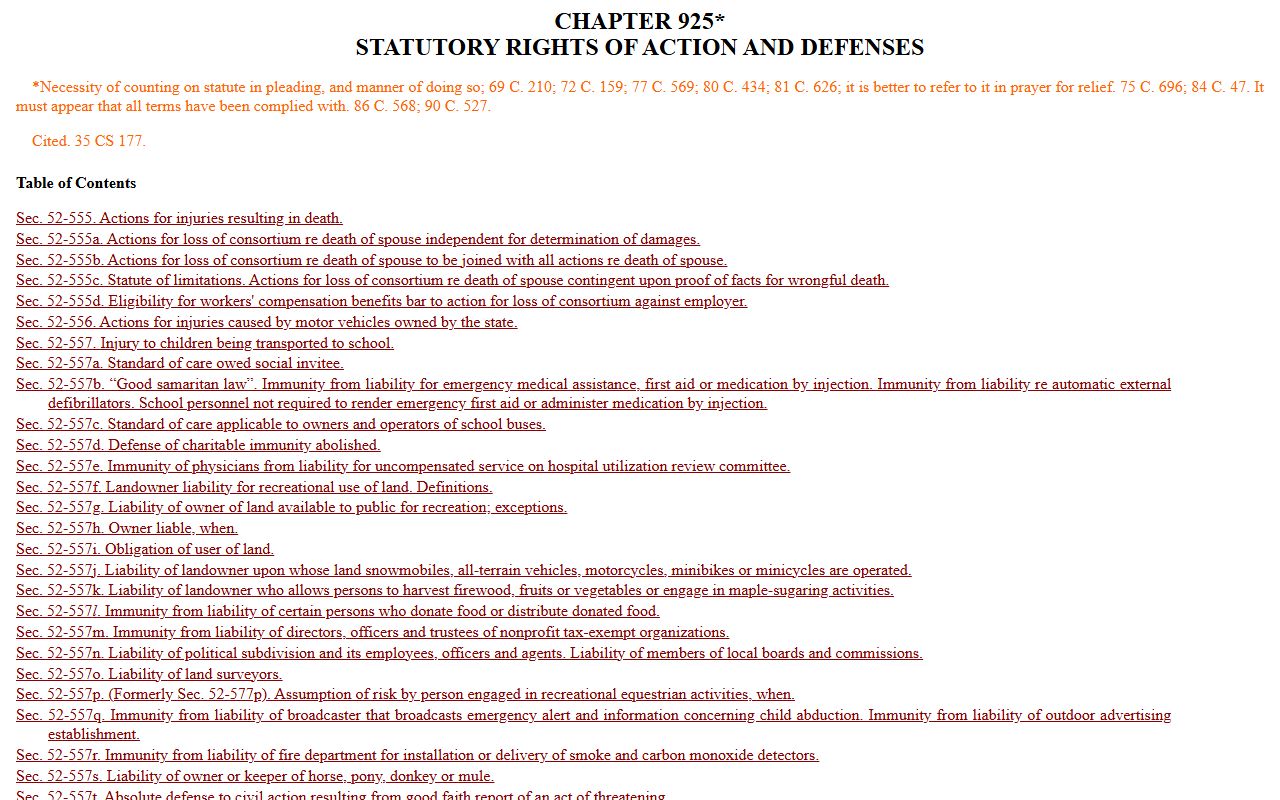
Connecticut exemption statutes define what property debtors may retain when filing for bankruptcy relief in the state.
Legal Help for Connecticut Bankruptcy Cases
Connecticut Legal Services provides free assistance to low-income residents. Call 800-453-3320 to request help. This organization handles consumer bankruptcy matters for qualifying individuals. They also address related issues like foreclosure defense and debt collection abuse. Services are available statewide with offices in multiple locations.

Connecticut Legal Services offers free legal representation to eligible low-income residents facing bankruptcy proceedings.
The Connecticut Bar Association operates a lawyer referral service. Call 860-223-4400 for attorney recommendations. They connect callers with qualified bankruptcy attorneys. Initial consultations cost up to $50 for 30 minutes. This service helps find experienced counsel for complex cases. The Bar Association website at www.ctbar.com provides additional resources.
Federal Pro Se programs assist self-represented litigants. The court offers limited guidance to debtors filing without attorneys. Contact the U.S. District Court Clerk's Office at 860-240-3200 in Hartford. Pro se filers must follow all rules and procedures. The court recommends consulting an attorney when possible. Self-represented debtors are responsible for proper document preparation and filing.
Approved credit counseling agencies are required before filing. The U.S. Trustee Program maintains the approved list. Search by state at www.justice.gov/ust. Debtors must complete counseling within 180 days before filing. Post-filing debtor education is also required for discharge. These courses address budgeting and financial management.
The U.S. Trustee Program oversees bankruptcy cases in Region 2. Their New York office serves Connecticut. They appoint trustees, monitor cases for abuse, and enforce bankruptcy laws. Contact them at 33 Whitehall Street, 5th Floor, New York, NY 10004. The phone is 212-510-0500. Their website at www.justice.gov/ust provides additional information.
Browse Connecticut Bankruptcy Records by County
Connecticut has eight counties, each with residents who may file for federal bankruptcy protection. Select a county below to find local resources, court locations, and specific information about accessing bankruptcy records in that area.
Bankruptcy Records in Major Connecticut Cities
Connecticut residents in major cities file bankruptcy cases at the federal courthouse serving their region. Select a city below to learn about local resources and bankruptcy record access in that community.